

Imagine walking into your office on a Monday morning feeling like you're carrying a lead backpack. You're not physically tired, but your brain feels like a browser with fifty tabs open, half of them frozen. This isn't just a 'bad day'-it's a signal that your psychological state is redlining. For a long time, we were told to leave our personal problems at the door, but let's be real: you can't surgically detach your brain from your emotions the moment you clock in.
Quick Takeaways for Busy Managers and Employees
- Unaddressed stress leads to a massive drop in productivity and a spike in absenteeism.
- Psychological safety is the number one predictor of high-performing teams.
- Small shifts in communication and boundary-setting can prevent long-term burnout.
- Mental health support isn't a "perk"; it's a core requirement for business sustainability.
The Real Cost of Ignoring the Mind at Work
When we talk about workplace mental health is the state of an employee's psychological and emotional well-being within their professional environment, we aren't just talking about the absence of a clinical diagnosis. We're talking about whether people feel capable, valued, and mentally energized. When a company ignores this, they aren't just being "old school"-they're losing money.
Think about the phenomenon of presenteeism. This is when an employee is physically at their desk but mentally checked out because of anxiety or depression. They might spend four hours staring at a spreadsheet without making a single edit. According to data from the World Health Organization, depression and anxiety cost the global economy roughly $1 trillion per year in lost productivity. That is a staggering number that proves mental health is a financial metric, not just a HR checkbox.
If you've ever felt the dread of a "quick sync" meeting that actually lasts two hours, or the panic of a midnight email from a boss, you've experienced the friction that erodes mental resilience. When this becomes the norm, the result is Burnout, which is a state of emotional, physical, and mental exhaustion caused by excessive and prolonged stress. It doesn't happen overnight; it's a slow leak that eventually leaves the tank empty.
Why Psychological Safety is the Secret Sauce
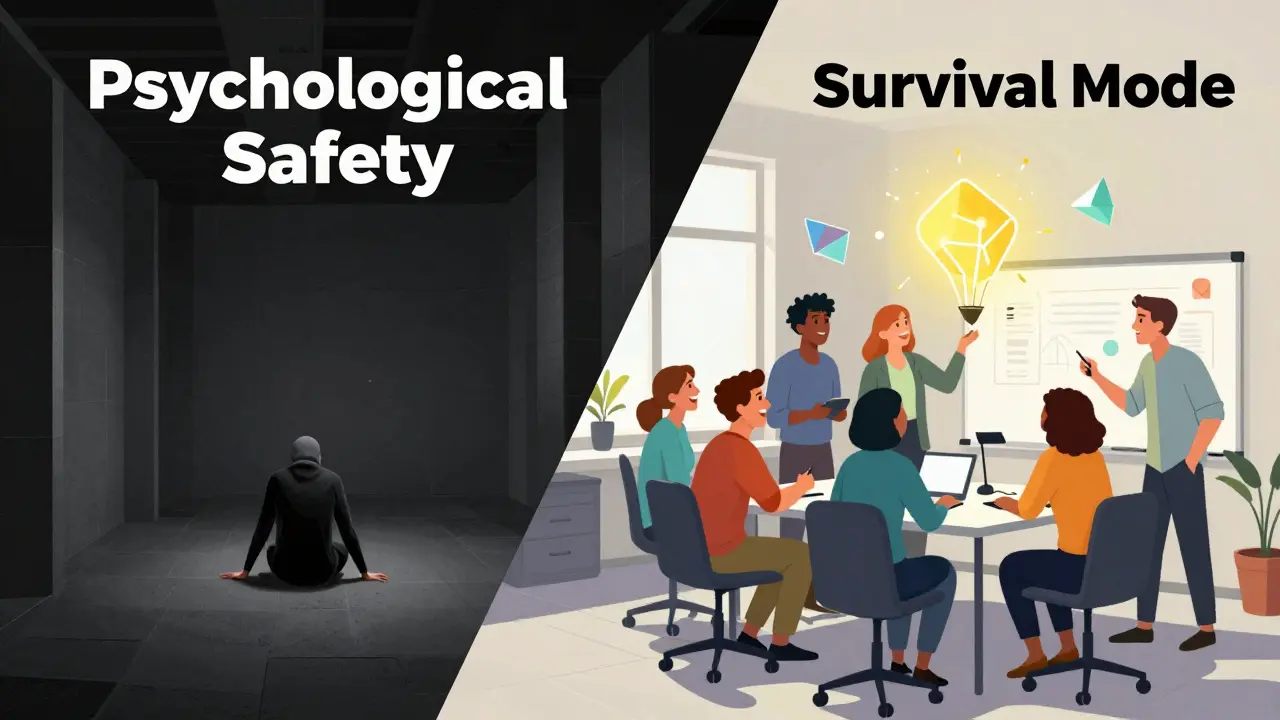
You might have heard the term Psychological Safety tossed around in corporate retreats. In simple terms, it's the belief that you won't be punished or humiliated for speaking up with ideas, questions, concerns, or mistakes. If you're terrified that admitting a mistake will get you fired or mocked, your brain stays in "survival mode."
When you're in survival mode, the prefrontal cortex-the part of your brain responsible for complex problem solving and creativity-essentially shuts down. Why? Because your brain is too busy scanning for threats. This is why the most innovative companies don't actually have the "smartest" people; they have the environments where people feel safest to be wrong. If you can't fail safely, you can't innovate.
| Environment Type | Employee Behavior | Business Outcome |
|---|---|---|
| High-Stress/Low-Support | Fear of mistakes, hiding errors | High turnover, costly failures |
| Supportive/Moderate-Stress | Open communication, collaboration | Steady growth, employee loyalty |
| Psychologically Safe/High-Trust | Risk-taking, rapid experimentation | Industry-leading innovation |
The Burnout Cycle and How to Break It
Burnout isn't just about working long hours. You can work 80 hours a week on a project you love and feel great, or work 30 hours a week in a toxic environment and feel completely depleted. The real culprit is often a lack of control and a lack of reward. When the effort you put in doesn't match the recognition or the result you get, your brain starts to associate work with pain.
To break this cycle, we need to look at Occupational Stress, which is the physical and emotional response that occurs when the requirements of the job do not match the capabilities, resources, or needs of the worker. This often manifests as "Sunday Scaries"-that tightening in your chest that starts around 4 PM on Sunday.
Breaking the cycle requires more than a "wellness Wednesday" yoga class. It requires structural changes. For example, instead of telling employees to "manage their stress," a company might implement "no-meeting Fridays" or strictly enforce a policy where emails are not answered after 7 PM. These are concrete boundaries that allow the nervous system to actually reset.
Practical Strategies for Employees: Protecting Your Peace
If you're in a workplace that hasn't caught up to the importance of mental health, you have to build your own fortifications. The most effective tool here is the "hard boundary." A hard boundary is a non-negotiable rule you set for yourself. For instance, "I do not check Slack during my lunch break."
Another powerful technique is the "transition ritual." When you work from home, the line between "office" and "sanctuary" disappears. Your brain doesn't know when the workday ends because the commute is now just walking from the laptop to the couch. Creating a ritual-like a 10-minute walk around the block, changing your clothes, or playing a specific playlist-signals to your brain that it is safe to switch from "work mode" to "rest mode."
Don't underestimate the power of micro-breaks. Using a technique like the Pomodoro Timer (working for 25 minutes, then resting for 5) prevents the cognitive fatigue that leads to mistakes. When you push through the tiredness, you aren't being productive; you're just practicing how to be exhausted.
The Manager's Playbook: Leading with Empathy
If you manage people, your primary job isn't actually managing tasks-it's managing energy. A team that is burnt out cannot execute a strategy, no matter how brilliant the plan is. The first step in supporting your team is normalizing the conversation. When a leader admits, "I'm feeling a bit overwhelmed this week, so I'm taking a half-day on Friday to recharge," it gives everyone else permission to be human.
Avoid the trap of "toxic positivity." Telling a struggling employee to "just stay positive" or "look on the bright side" is a form of gaslighting. It dismisses their experience and makes them feel isolated. Instead, try validating their experience: "It sounds like the current workload is unsustainable. Let's look at your task list together and see what we can push back or delegate." This moves the problem from an internal emotional struggle to a collaborative logistical challenge.
Implement a Employee Assistance Program (EAP), which is a work-based intervention program designed to identify and help employees with personal problems. An EAP provides a confidential bridge to professional counseling and legal or financial advice, removing the stigma of seeking help.

Creating a Long-Term Culture of Wellness
A healthy workplace isn't one where people never get stressed; it's one where they have the tools to recover from that stress. This means moving away from the "hero culture" where the person who stays the latest and sleeps the least is praised. That culture is a recipe for a high-turnover disaster.
Instead, focus on autonomy. When people have a say in how they do their work and when they do it, their stress levels drop significantly. This is why flexible work arrangements aren't just about convenience-they are mental health interventions. Trusting your employees to manage their own time reduces the anxiety of constant surveillance and increases their sense of ownership.
Finally, integrate regular "wellbeing check-ins" into your 1-on-1s. Instead of only asking about project deadlines, start with a simple question: "On a scale of 1 to 10, how is your capacity this week?" If someone says 3, you don't ask them to work harder; you ask how you can help them get back to a 6 or 7. This creates a feedback loop of support that prevents small stresses from becoming full-blown crises.
How do I bring up my mental health struggles with my boss without sounding "weak"?
The key is to frame the conversation around performance and solutions rather than just emotions. Instead of saying "I'm struggling," try: "I've noticed my productivity is dipping because of some personal challenges, and I want to make sure the quality of my work stays high. Can we discuss adjusting my deadlines for the next two weeks so I can get back on track?" This shows you are committed to your job while being honest about your needs.
What are the warning signs that a coworker might be burning out?
Look for changes in baseline behavior. Someone who was usually punctual starts arriving late or missing meetings. A normally collaborative person becomes cynical, irritable, or withdrawn. You might also notice a drop in the quality of their work or an increase in small, uncharacteristic mistakes. The most telling sign is often a shift in tone-from being engaged and optimistic to sounding exhausted or defeated.
Does providing a gym membership actually help workplace mental health?
It can help, but it's a superficial fix if the work culture is toxic. Exercise is great for managing stress, but if an employee is working 12-hour days, they won't have the time or energy to use the gym. Wellness perks should be the "cherry on top," not the foundation. The real work happens in how tasks are assigned, how communication is handled, and whether employees feel safe to take time off.
What is the difference between a bad day and clinical burnout?
A bad day is temporary; you feel better after a good night's sleep or a weekend off. Burnout is chronic. It's characterized by a sense of detachment, a feeling of inadequacy (no matter how much you achieve), and physical exhaustion that doesn't go away with a nap. If you've had a vacation and you still feel dread and exhaustion the moment you think about work, you are likely dealing with burnout.
Can remote work actually make mental health worse?
Yes, it can. While it removes the commute, it often creates "digital isolation" and the "always-on" mentality. Without the physical act of leaving an office, many people find themselves working longer hours and feeling lonely. To combat this, it's essential to set strict log-off times and intentionally schedule non-work social interactions to maintain a sense of connection.
Next Steps for Improving Your Work Life
Depending on where you stand in your career, your approach should differ:
- For the Individual: Start by auditing your boundaries. Where are you saying "yes" when you want to say "no"? Pick one hard boundary this week and stick to it.
- For the Mid-Level Manager: Start implementing the "capacity check" in your 1-on-1s. Move from asking "Is it done?" to "How are you doing with the load?"
- For the Executive: Review your company's incentive structures. Are you rewarding the people who burn out? Shift your recognition toward efficiency and sustainable output rather than raw hours worked.