Life today moves too fast. Emails pile up, notifications buzz nonstop, and the pressure to be always on never lets up. If you’ve ever felt your heart racing after a meeting, or your jaw clenched before bed, you’re not alone. Modern stress isn’t just a feeling-it’s a physical burden. But the good news? Your body already knows how to calm down. You just need to give it the right signal.
Why Your Body Needs Relaxation
Your nervous system has two main modes: fight-or-flight and rest-and-digest. Right now, most of us are stuck in fight-or-flight. Chronic stress floods your body with cortisol and adrenaline. Over time, that raises blood pressure, weakens immunity, and messes with sleep. Studies from the American Psychological Association show that over 75% of adults report physical symptoms from stress-headaches, muscle tension, fatigue. But here’s the key: relaxation isn’t a luxury. It’s a biological reset.
When you activate the rest-and-digest response, your heart rate slows, muscles loosen, and digestion kicks in. Your body starts repairing itself. This isn’t just about feeling calmer. It’s about preventing long-term damage.
Deep Breathing: Your Instant Reset Button
The simplest, fastest relaxation technique you have? Breathing. Not just any breathing-slow, controlled breaths. Try this: inhale through your nose for four counts, hold for four, exhale through your mouth for six. Repeat five times.
Why does this work? When you lengthen your exhale, you trigger the vagus nerve-the main line of communication between your brain and your body’s relaxation system. A 2023 study in Frontiers in Psychology found that just three minutes of this breathing pattern dropped cortisol levels by 24% in stressed adults.
Do this before a meeting. Before checking your phone at night. Even while waiting in line. It takes no equipment, no time, and it works anywhere.
Progressive Muscle Relaxation: Tense to Release
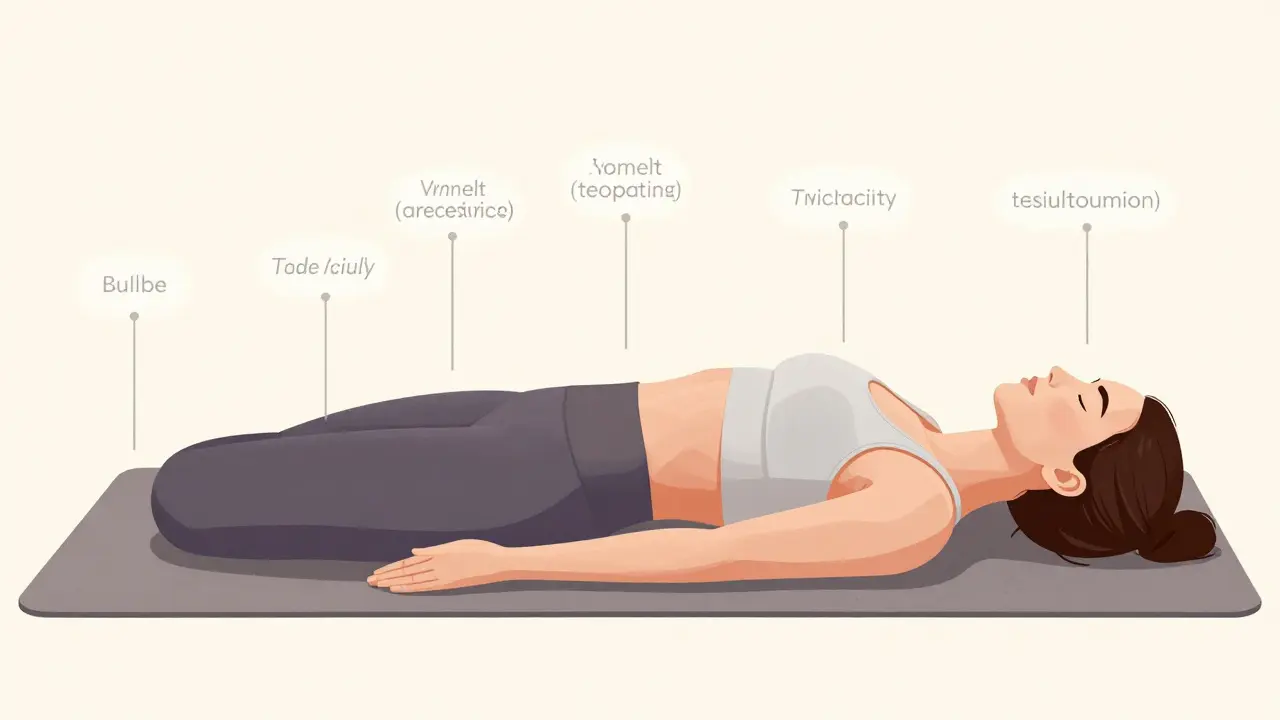
Stress locks your muscles. Your shoulders hunch. Your forehead tightens. Your jaw grinds. Progressive muscle relaxation (PMR) teaches you to notice that tension-and let it go.
Here’s how:
- Start with your toes. Curl them tightly for five seconds.
- Then release. Feel the warmth, the softness.
- Move up: feet, calves, thighs, abdomen, hands, arms, shoulders, neck, face.
- Each time, tense for five seconds, then relax for ten.
You’ll be surprised how much tension you carry. A 2024 trial from the University of Queensland found that people who practiced PMR five times a week for four weeks reported a 40% drop in daily stress levels. It’s especially helpful if you’re the type who doesn’t realize they’re tense until they’re in pain.
Mindfulness: Being Here, Not There
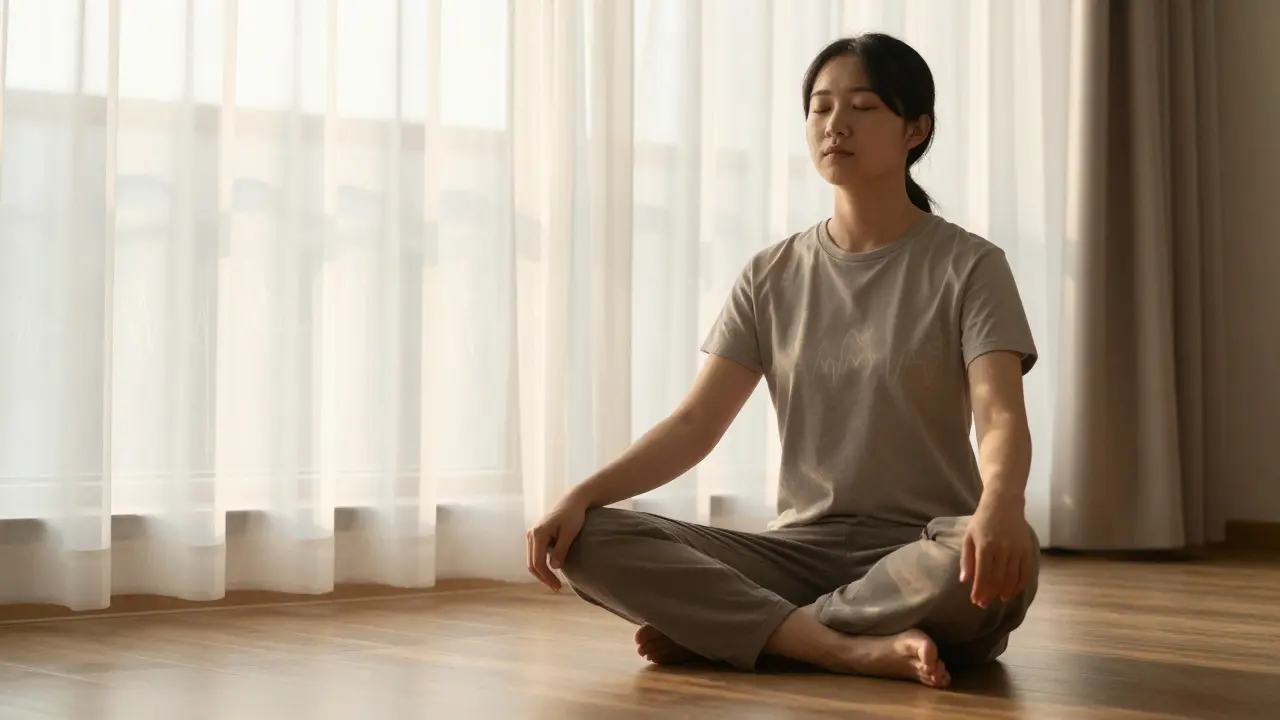
Mindfulness isn’t about emptying your mind. It’s about noticing what’s happening-without judgment. That’s it.
Try this: Sit quietly. Focus on your breath. When your mind wanders (and it will), gently bring it back. No scolding. No frustration. Just return.
That’s the practice. It’s not about achieving peace. It’s about catching yourself when you’re spiraling. Research from Harvard Medical School shows that just eight weeks of daily mindfulness practice shrinks the amygdala-the brain’s fear center-and thickens the prefrontal cortex, which handles rational thinking. Translation? You react less, respond more.
You don’t need an app or a cushion. Just five minutes a day. While your coffee cools. Before you get out of bed. While walking to the car.
Guided Imagery: Your Mental Escape
Close your eyes. Picture a place where you feel completely safe. Maybe it’s a beach. A forest. A cozy room with a fireplace. Now, add details. What do you hear? The waves? Birds? The crackle of wood? What do you smell? Salt air? Pine? Burnt toast? Feel the temperature. The texture under your feet.
This is guided imagery. It works because your brain doesn’t distinguish much between real and imagined experiences. A 2025 meta-analysis in the Journal of Clinical Psychology found that guided imagery reduced anxiety as effectively as cognitive behavioral therapy for people with moderate stress.
Use it when you need to reset fast. Before a tough conversation. After a bad day. When you can’t sleep. Find a free audio guide online-or make your own. Record yourself describing your safe place. Play it when you need it.

Why These Techniques Work Better Than You Think
Some people think relaxation is too simple to matter. But science says otherwise. These aren’t just feel-good tricks. They’re evidence-based tools that change your biology.
Deep breathing lowers cortisol. PMR reduces muscle pain linked to stress. Mindfulness rewires your brain. Guided imagery calms your nervous system faster than medication for some people.
And here’s the best part: you don’t need to do all of them. Pick one. Stick with it for two weeks. Notice how you feel. Then try another. The goal isn’t perfection. It’s consistency.
What Doesn’t Work
Not all relaxation advice is equal. Avoid these traps:
- Scrolling to relax. Social media spikes dopamine and cortisol. It’s stimulation, not rest.
- Waiting until you’re overwhelmed. Waiting for a breakdown to try calming techniques is like waiting for a flat tire to learn how to change it.
- Thinking you need hours. Five minutes of deep breathing is more effective than an hour of distracted "me time."
Relaxation isn’t about escaping life. It’s about returning to yourself.
Start Today-No Equipment Needed
Here’s your simple plan:
- Choose one technique: deep breathing, PMR, or mindfulness.
- Do it for five minutes, once a day, for seven days.
- Write down how you felt before and after.
- On day eight, try a second technique.
You don’t need to join a class. Buy a subscription. Or meditate on a mountain. Just show up for yourself. Even for five minutes. Every day.
Stress isn’t going away. But you don’t have to carry it alone. Your body is built to recover. You just need to give it the chance.