

Parenting is messy. It’s loud. It’s exhausting. And no matter how prepared you think you are, there will be mornings when the toddler is screaming, the baby won’t stop crying, the dog just vomited on the rug, and your partner is late for work again. In those moments, your body goes into survival mode-heart racing, shoulders tight, breath shallow. You know you need to calm down, but how? You don’t have time for a 30-minute meditation. You don’t even have time to sit down.
Stop Trying to Be Perfect
The biggest myth about staying calm as a parent is that you need to be calm all the time. You don’t. You just need to be calm enough to get through the next five minutes. Research from the University of California shows that parents who accept their emotional spikes-instead of fighting them-recover faster and feel less guilty afterward. You’re not failing because you snapped. You’re human. The goal isn’t to never lose your cool. It’s to find your way back to calm, quickly and without self-judgment.Three Breathing Tricks That Actually Work (No Meditation Required)
When your kid throws a tantrum in the grocery store and you feel your face turning red, your nervous system is screaming for help. You can’t walk away. You can’t close your eyes. But you can breathe. Here are three simple techniques you can use anywhere, anytime:- 4-7-8 Breath: Breathe in through your nose for 4 seconds. Hold for 7. Exhale slowly through your mouth for 8. Repeat three times. This triggers your parasympathetic nervous system-the one that says, “We’re safe now.”
- Box Breathing: Inhale for 4, hold for 4, exhale for 4, hold for 4. Think of it like tracing a square with your breath. It’s used by Navy SEALs to stay focused under pressure. Works just as well when your child is painting the wall with peanut butter.
- Hand-on-Chest Breathing: Place one hand on your chest, the other on your belly. Breathe so your belly rises first, then your chest. Do this for just 30 seconds. It forces your body out of fight-or-flight mode. No one has to know you’re doing it.
These aren’t magic. But they’re science-backed, and they work in under a minute. Try one next time you feel your blood pressure rising. You’ll notice the difference before your kid even finishes their meltdown.
Grounding: When Your Mind Is Racing and You Can’t Stop
Ever feel like your thoughts are spinning in circles? “What if they get sick?” “Why won’t they sleep?” “I’m never going to get anything done.” That’s your brain trying to solve problems that don’t exist yet. Grounding pulls you back into your body-and into the present.Try the 5-4-3-2-1 method:
- Name 5 things you can see right now (the red sippy cup, the crack in the ceiling, your child’s sock, the fridge light, the cat staring at you).
- Name 4 things you can touch (the cool countertop, the soft blanket, your own shirt, the plastic spoon in your hand).
- Name 3 things you can hear (the dishwasher humming, your kid humming a tune, the wind outside).
- Name 2 things you can smell (the coffee you spilled, the laundry detergent).
- Name 1 thing you can taste (the mint you chewed this morning, the lingering tea).
This isn’t fluff. It’s a proven technique used in trauma therapy to interrupt panic. It takes 20 seconds. And it stops the spiral before it takes over.

Micro-Moments of Calm (No Extra Time Needed)
You don’t need to carve out time for self-care. You need to steal it-five seconds here, ten seconds there.- While waiting for the kettle to boil: Feel the warmth of the mug in your hands. Don’t think. Just feel.
- While brushing your teeth: Notice the taste of the toothpaste. The sound of the bristles. The rhythm of your arm.
- While standing in the driveway waiting for the school bus: Take three slow breaths. Look up at the sky. Notice if there are clouds. If not, that’s okay too.
These aren’t distractions. They’re resets. Your nervous system doesn’t need hours of silence. It needs tiny, repeated moments of safety. And you can build them into the cracks of your day.
Why Movement Helps More Than Sitting Still
Most relaxation advice tells you to sit still. But if you’ve ever tried to meditate while your toddler is banging pots in the next room, you know that doesn’t work. Movement is often the better tool.Shake it out. Literally. Stand up. Shake your arms like you’re drying off after a shower. Do it for 15 seconds. Then stomp your feet. Jump up and down once. It sounds silly. But shaking releases tension stored in your muscles-something your body knows how to do naturally after a scare. Animals shake after a near-miss. Humans? We hold it in. Letting go-even a little-changes your state.
Or try this: Walk to the mailbox. Don’t think about what you need to do next. Just feel your feet hitting the ground. Notice the air on your skin. That’s a moving meditation. And it’s free.
When You’re Too Tired to Breathe
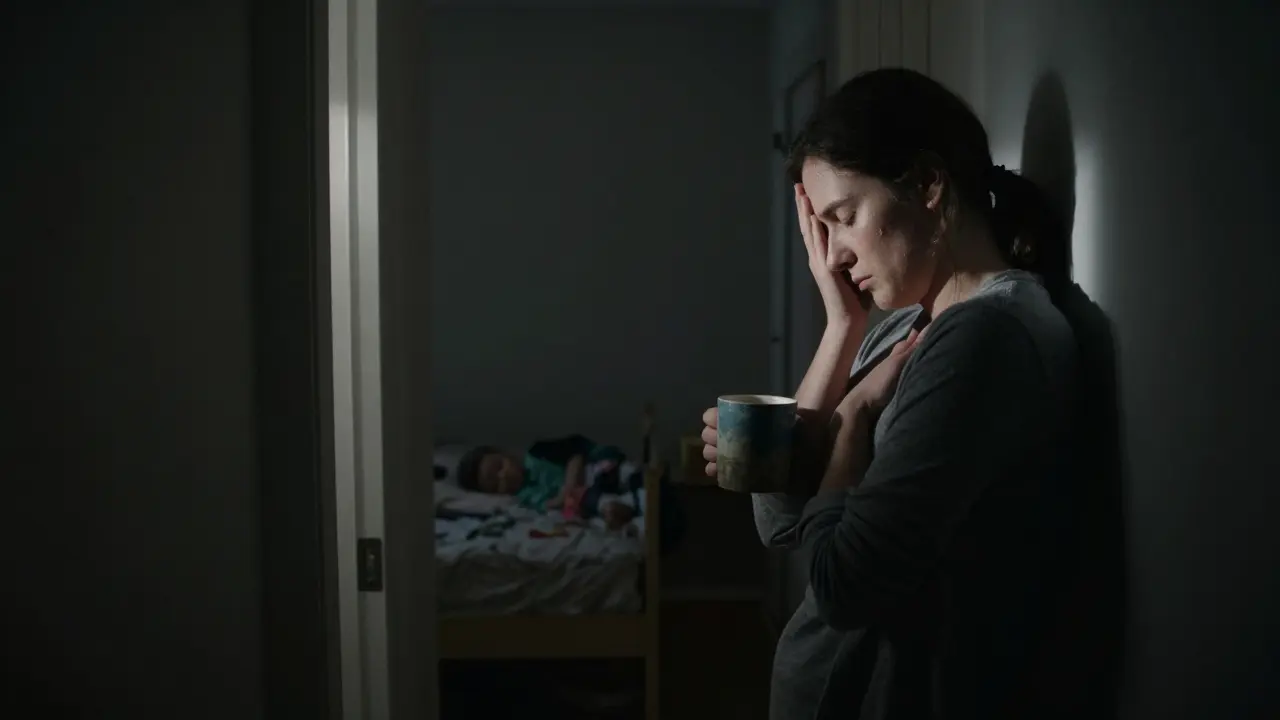
Some days, you’re not just stressed. You’re bone-deep exhausted. Your brain is fried. Your body feels like it’s running on fumes. In those moments, breathing techniques won’t help. What will?Touch.
Put your hand on your chest. Hold your own arm. Hug yourself. Press your forehead into your palm. Even a 10-second self-hug releases oxytocin-the same hormone that bonds mothers to babies. It calms your nervous system. It tells your brain: “You’re safe. You’re held.”
And if you have someone nearby-a partner, a friend, a neighbor-ask for a hug. Say it out loud: “I need a hug.” You’d do it for your kid. Do it for yourself.
What to Do When Nothing Seems to Work
Sometimes, despite all the breathing, the grounding, the shaking-you still feel like you’re falling apart. That’s okay. It doesn’t mean you’re broken. It means you’re overwhelmed.Here’s what to do next:
- Let someone else take over for 10 minutes. Even if it’s just handing your toddler to your partner and saying, “I need five minutes alone.”
- Turn on one song you love. Not background music. One song. Close your eyes. Let it fill you up. Don’t think about laundry. Just listen.
- Write one sentence in a notebook: “Today, I felt ______.” Don’t fix it. Just name it.
Recovery isn’t always about fixing. Sometimes, it’s about surviving until the next breath.
You’re Not Alone in This
A 2024 survey by the Australian Institute of Family Studies found that 73% of parents report feeling overwhelmed daily. That’s not a personal failure. That’s a normal response to an impossible job. No one trains you for this. No one tells you it’s okay to feel this way.But it is okay.
You don’t need to be calm all the time. You just need to know how to find calm again. And you already have the tools. You just forgot you had them.
Start small. One breath. One grounding moment. One self-hug. That’s enough.
Can relaxation techniques really help with parenting stress?
Yes. Studies from the American Psychological Association show that parents who use even simple breathing and grounding techniques report lower stress levels, better emotional control, and improved relationships with their children. These aren’t luxury practices-they’re survival tools. You don’t need to meditate for hours. Just a few seconds of focused breathing can reset your nervous system and help you respond instead of react.
What if I don’t have time for relaxation?
You don’t need time-you need moments. Relaxation doesn’t mean sitting quietly for 20 minutes. It means noticing your breath while the kettle boils. Feeling your feet on the ground while waiting for the bus. Shaking out your arms for 15 seconds between tasks. These micro-moments add up. They’re not extra. They’re essential. Your brain needs them to reset, just like your phone needs to recharge.
Is it selfish to take time for myself as a parent?
No. It’s necessary. Think of it like putting on your own oxygen mask first. If you’re running on empty, you can’t give your kids the calm, patient presence they need. Taking a moment to breathe, ground, or hug yourself isn’t selfish-it’s what keeps you able to show up. Your kids don’t need a perfect parent. They need a present one.
Can children benefit from seeing their parents relax?
Absolutely. Children learn emotional regulation by watching adults. When they see you take a breath before answering a tantrum, they learn that big feelings don’t have to lead to big reactions. When they see you take a walk to calm down, they learn that it’s okay to step away. Your calm becomes their blueprint.
What’s the quickest way to calm down when I’m already yelling?
Stop. Breathe. Say, “I need a minute.” Then step away for 30 seconds-even just go to the bathroom, close the door, and do one round of 4-7-8 breathing. You don’t have to be perfect. You just have to pause. That pause gives your brain time to shift from rage to response. It’s not about avoiding anger. It’s about not letting it control you.
Next Steps: Start With One Thing
Pick one technique from this article. Just one. Try it tomorrow during your next moment of chaos. Maybe it’s the 4-7-8 breath while waiting for the microwave. Maybe it’s the 5-4-3-2-1 grounding while your kid is throwing cereal. Maybe it’s just hugging yourself for 10 seconds before you answer their third question of the day.You don’t need to change everything. You just need to start. One breath. One moment. One reset. That’s how calm returns-not in grand gestures, but in small, repeated acts of self-kindness.