

You’ve probably heard these terms thrown around in the same breath. Meditation. Mindfulness. They sound like they mean the same thing, don’t they? If you’re looking to reduce stress or improve your focus, it’s easy to assume they are interchangeable synonyms. But here is the catch: treating them as identical might be holding you back from getting the most out of your practice.
Think of it this way. One is a specific activity, like going to the gym. The other is a mindset, like being fit. You can go to the gym without being fit yet, and you can be fit without going to the gym every single day. Similarly, meditation is a structured practice you sit down to do, while mindfulness is a quality of attention you bring to your life, whether you are sitting on a cushion or washing dishes.
Understanding this distinction isn't just academic nitpicking. It changes how you approach your mental well-being. When you know which tool fits which job, you stop feeling guilty for "not meditating enough" and start noticing opportunities to be present right now. Let’s break down exactly what each one is, how they overlap, and why you need both in your toolkit.
Meditation: The Structured Practice
Meditation is a family of mental training practices designed to cultivate concentration, awareness, and emotional balance. At its core, meditation is an intentional act. You set aside time-usually ten, twenty, or thirty minutes-and you follow a specific protocol. This makes it distinct from general relaxation. Relaxation happens to you; meditation is something you do.
There are many types of meditation, but they generally fall into two buckets: focused attention and open monitoring.
- Focused Attention: You pick one anchor point-your breath, a candle flame, a mantra (a repeated word or phrase)-and you return to it whenever your mind wanders. This is like weightlifting for your brain’s focus muscle. Every time you notice you’ve drifted off and gently bring your attention back, you are doing a rep.
- Open Monitoring: Instead of focusing on one thing, you observe whatever arises in your field of awareness-thoughts, sounds, bodily sensations-without judging them or getting caught up in them. This builds meta-awareness, the ability to watch your mind at work.
The beauty of meditation is that it is measurable. You either sat down and did it, or you didn’t. This structure provides a safe container for beginners. If you try to "just be mindful" all day without any training, you might find yourself overwhelmed by the noise in your head. Meditation gives you the space to practice noticing that noise without reacting to it.
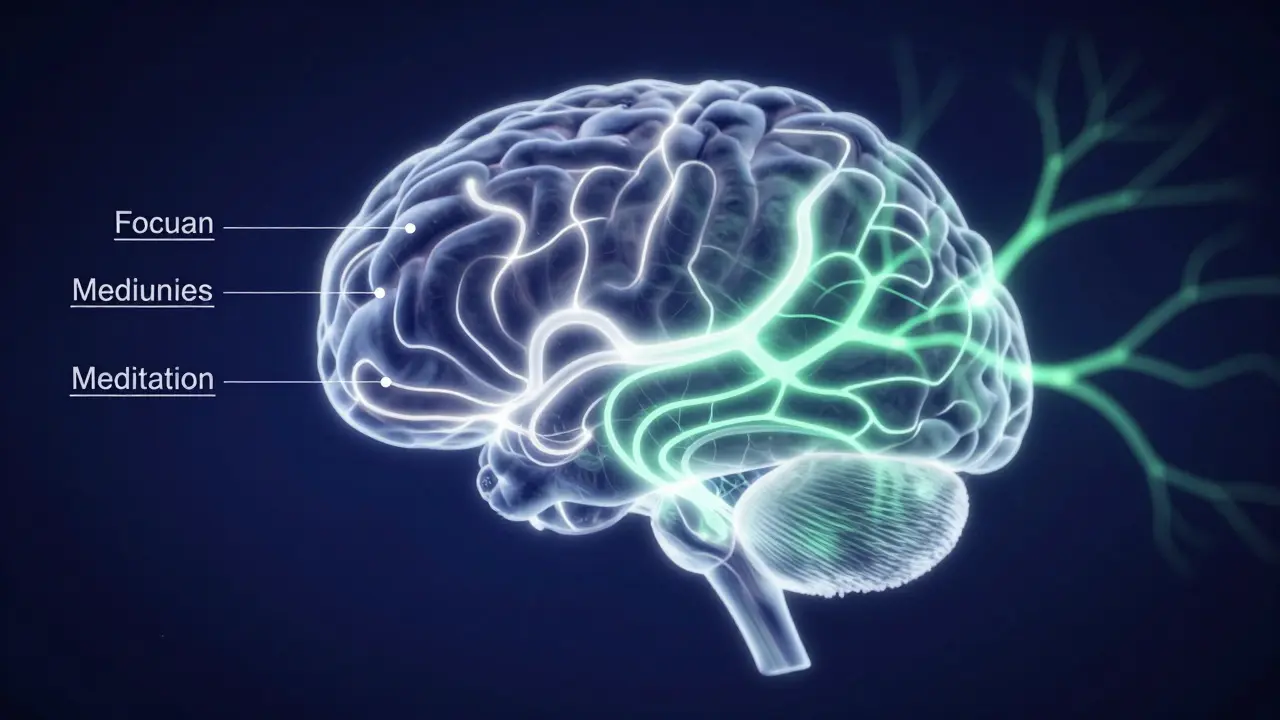
Research supports this structured approach. Studies using MRI scans have shown that consistent meditation practice (often defined as 10-20 minutes daily for eight weeks) leads to structural changes in the brain. Specifically, it increases gray matter density in the hippocampus, which is involved in learning and memory, and decreases gray matter density in the amygdala, the area associated with stress and anxiety. Essentially, meditation physically rewires your brain to handle stress better.
Mindfulness: The Quality of Presence
If meditation is the gym, Mindfulness is the fitness level you carry with you everywhere. Mindfulness is not a technique you perform; it is a state of being. It is the simple act of paying attention to the present moment, on purpose, and without judgment.
This definition, popularized by Jon Kabat-Zinn, breaks down into three key components:
- Paying Attention: Directing your focus to what is happening right now, not five minutes ago or five hours from now.
- On Purpose: Doing this intentionally, rather than drifting through life on autopilot.
- Without Judgment: Observing your experience without labeling it as "good" or "bad." If you feel angry, you note, "I am feeling anger," rather than, "I shouldn't be angry, this is stupid."
Mindfulness looks different depending on where you are. In the office, it might mean fully listening to a colleague instead of planning your response while they speak. In the kitchen, it means tasting the texture and flavor of your food instead of scrolling through your phone. On the couch, it might mean noticing the tension in your shoulders and consciously relaxing them.
The power of mindfulness lies in its accessibility. You don’t need a quiet room, a cushion, or silence. You can practice mindfulness in a crowded train station, during a heated argument, or while waiting in line at the grocery store. It is the art of interrupting the automatic pilot mode that runs most of our lives.
Consider the concept of "autopilot." Most adults spend nearly half their waking hours thinking about something other than what they are currently doing. This mind-wandering is linked to unhappiness. Mindfulness pulls you out of the past (regret) and the future (worry) and anchors you in the only place where life actually happens: the present.
The Overlap: How They Feed Each Other
So, if they are different, why are they always paired together? Because they are symbiotic. Meditation trains the skill; mindfulness applies it.
Imagine you are learning to play the guitar. You practice scales and chords alone in your bedroom. That is meditation. Then, you go to a jam session with friends. That is mindfulness. Without the solo practice, you might struggle to keep up in the jam session. Without the jam session, your solo practice has no real-world context.
Meditation creates the "muscle memory" for attention. When you sit quietly and practice returning to your breath, you are strengthening the neural pathways associated with focus. Over time, this makes it easier to catch yourself when you are distracted in daily life. You become more aware of the gap between a stimulus (someone cutting you off in traffic) and your response (yelling). That gap is where mindfulness lives.
Conversely, bringing mindfulness into your daily life reinforces your meditation practice. When you notice yourself getting frustrated while cooking dinner, you can use that moment as a mini-meditation. You pause, breathe, and observe the frustration. This real-time application deepens your understanding of how your mind works, making your formal meditation sessions more insightful.
| Feature | Meditation | Mindfulness |
|---|---|---|
| Nature | A structured practice/activity | A state of awareness/mindset |
| Setting | Usually quiet, dedicated space | Anywhere, anytime |
| Goal | To train attention and calm the mind | To be present and non-judgmental |
| Duration | Fixed period (e.g., 10-30 mins) | Ongoing throughout the day |
| Analogy | Going to the gym | Being fit |
Common Misconceptions to Avoid
One of the biggest hurdles people face is misunderstanding what these practices are supposed to achieve. Let’s clear up some myths.
Myth 1: Meditation is about stopping thoughts. If you think meditation means clearing your mind completely, you will likely quit within a week. Everyone has thoughts. The goal is not to stop them, but to change your relationship with them. Instead of getting swept away by a thought stream, you learn to watch it flow by like clouds in the sky. This is a subtle but crucial difference.
Myth 2: Mindfulness is just positive thinking. Mindfulness is not about forcing yourself to feel happy or ignoring negative emotions. It is about acknowledging reality as it is. If you are sad, mindfulness allows you to feel the sadness fully without adding a layer of self-criticism ("I’m so weak for feeling this way"). This acceptance often leads to natural relief, but the primary goal is clarity, not happiness.
Myth 3: You need to be spiritual to practice. While meditation has roots in various spiritual traditions, modern secular mindfulness and meditation are grounded in psychology and neuroscience. You do not need to believe in anything specific to benefit from reduced cortisol levels or improved focus. It is a mental hygiene practice, similar to brushing your teeth.
Practical Ways to Integrate Both Into Your Day
You don’t need to overhaul your life to start benefiting from these tools. Start small. Here is a realistic approach for someone with a busy schedule.
Step 1: Establish a Formal Meditation Habit Pick a consistent time. Morning is often best because your mind is relatively fresh, and it sets the tone for the day. Start with just five minutes. Use a timer. Sit comfortably. Focus on your breath. When your mind wanders (and it will), gently bring it back. Do not judge yourself for wandering. The "rep" is the returning, not the staying focused.
Step 2: Create Mindfulness Anchors Choose three routine activities during your day to turn into mindfulness moments. These could be:
- Brushing your teeth: Feel the bristles, taste the toothpaste, notice the warmth of the water.
- Walking to your car or desk: Feel the ground beneath your feet, notice the air temperature, look at the sky instead of your phone.
- Eating lunch: Put away distractions. Chew slowly. Notice the flavors and textures.
Step 3: Use the "Pause" Technique When you feel stress rising-whether it’s an email notification or a traffic jam-take one conscious breath before reacting. This tiny pause creates space between the trigger and your response. It is a micro-dose of mindfulness that prevents escalation.

The Science Behind the Benefits
Why does this matter beyond feeling calm? Because chronic stress is a physical burden on the body. Long-term activation of the stress response system (the HPA axis) leads to inflammation, high blood pressure, and weakened immunity.
Meditation and mindfulness directly counteract this. By activating the parasympathetic nervous system (the "rest and digest" mode), they lower heart rate and blood pressure. A landmark study published in *JAMA Internal Medicine* found that mindfulness meditation programs resulted in moderate evidence of improved anxiety, depression, and pain. While the effect sizes were modest, they were comparable to those seen with antidepressant medications in some cases, without the side effects.
Furthermore, these practices enhance cognitive function. They improve working memory and the ability to filter out irrelevant information. In a world full of digital distractions, this ability to sustain attention is becoming a competitive advantage, not just for personal peace, but for professional performance.
Troubleshooting Your Practice
It is normal to hit bumps along the way. Here is how to handle common challenges.
I can’t stop thinking. Remember, the goal isn’t to stop thinking. It’s to notice thinking. If you catch yourself thinking, you have succeeded. Celebrate the catch, not the distraction.
I don’t have time.
I feel restless or uncomfortable.
Can I practice mindfulness without meditating?
Yes, you can. Mindfulness is a quality of attention you can apply to any activity. However, formal meditation acts as training that makes it easier to maintain mindfulness in challenging situations. Think of it like stretching before running; you can run without stretching, but it helps prevent injury and improves performance.
How long does it take to see benefits from meditation?
Many people report feeling calmer after just a few sessions. However, significant neurological changes and sustained behavioral shifts typically require consistent practice over several weeks. Studies often cite eight weeks of daily practice (10-20 minutes) as a benchmark for measurable brain changes.
Is mindfulness the same as being relaxed?
Not necessarily. Mindfulness involves observing your current state without judgment. If you are stressed, mindfulness allows you to recognize the stress clearly. This recognition can lead to relaxation, but the primary goal is awareness. Sometimes, being mindful means acknowledging that you are not relaxed, which is the first step toward changing that state.
What is the best type of meditation for beginners?
Focused attention meditation, particularly breath awareness, is usually the best starting point. It provides a clear, simple object to focus on, which helps anchor the mind. Guided meditations via apps can also be helpful for beginners who need structure and direction.
Does mindfulness help with anxiety?
Yes, mindfulness is widely recognized as an effective tool for managing anxiety. By anchoring attention in the present moment, it interrupts the cycle of worry about the future. Clinical interventions like Mindfulness-Based Stress Reduction (MBSR) and Mindfulness-Based Cognitive Therapy (MBCT) are evidence-based treatments for anxiety disorders.